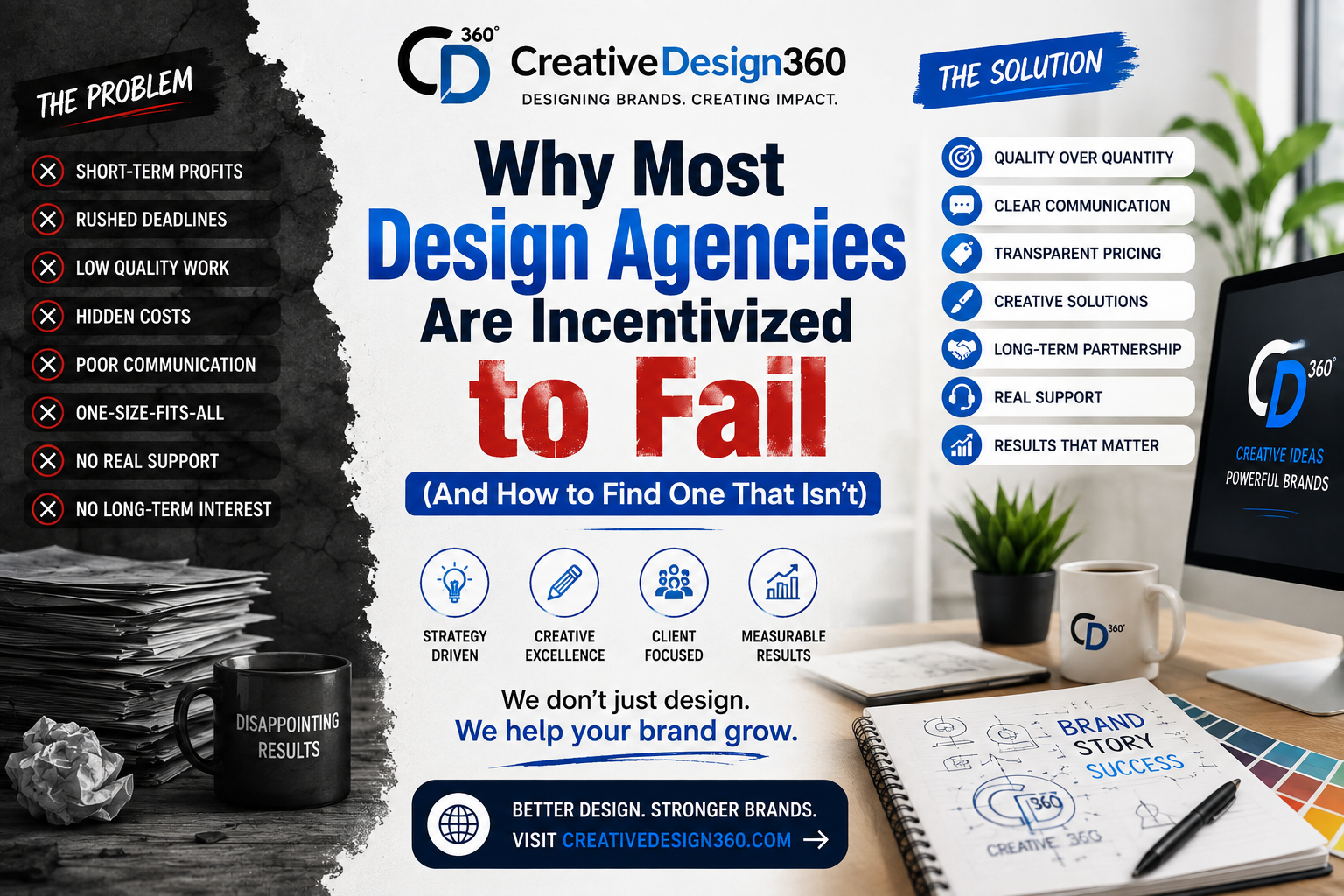
Why Most Design Agencies Are Incentivized to Fail (And How to Find One That Isn't)

Why Most Design Agencies Are Incentivized to Fail (And How to Find One That Isn't)
Here's something design agencies won't tell you: their financial incentives rarely align with yours.
Most agencies bill by the hour. More hours = more revenue. That structure rewards inefficiency and complexity. A design that takes longer to produce makes the agency more money, even if a simpler solution would serve you better.
Other agencies bill fixed-price per project. That flips the incentive. Now they're rewarded for finishing fast, whether the work is thorough or not. Research gets cut. Testing gets skipped. Deliverables get rushed.
Neither model ties agency success to your success.
This structural problem explains why so many design engagements feel frustrating. You want outcomes. They want to deliver a package and move on. Those goals aren't aligned.
Understanding this misalignment changes everything about how you evaluate, hire, and work with creative design services.
The Hourly Model Problem
Hourly billing is transparent and simple. It's also toxic to good design work.
The agency makes more money when projects take longer. That's not malicious; it's just math. But it creates subtle pressures. Research phases expand. Iteration cycles multiply. Deliverables become more complex than necessary.
The agency also has no stake in your outcome. If the design performs poorly, they still get paid. If it performs well, they don't earn more. The connection between their effort and your results is broken.
Savvy clients push back. They demand estimates and cap hours. The agency then front-loads the estimate to protect margin, which means you pay more upfront for work that may not be necessary.
You're in an adversarial position from the start.
The Fixed-Price Problem
Fixed-price projects solve one problem and create others. The agency knows exactly what they'll earn. You know exactly what you'll pay. Clean and predictable.
But now the agency is incentivized to minimize effort. Complete the project as quickly as possible. Reduce research to the bare minimum. Skip user testing if you don't specifically demand it. Deliver the files and move on.
Quality suffers. The agency focuses on scope completion, not outcome achievement. They check boxes. You get deliverables that may or may not solve your actual problem.
The fixed-price model also creates conflict around changes. Any adjustment to the scope triggers additional charges. This penalizes discovery. If you learn something new during the project, which is the whole point of research, it costs you extra to incorporate that learning.
What Actually Works
The best design engagements structure compensation around outcomes, not inputs.
Retainer models with outcome bonuses. A base monthly fee covers predictable work. An additional payment triggers when specific metrics improve. Conversion lifts, support ticket reductions, and activation rate improvements are all measurable and bonus-worthy.
Performance-based pricing. Some agencies now offer to work for a reduced base fee with significant upside tied to performance. This aligns incentives completely. They only earn top dollar when you earn top results.
Success fee structures. Post-launch payments tied to metric achievement. The agency doesn't collect their full fee until the design delivers what was promised.
These models are rare. Most agencies won't propose them. But they exist, and you can negotiate for them.
The Real Questions to Ask Before Hiring
Skip the portfolio questions. Skip the philosophy questions. Ask these instead.
"How do you handle research when the client doesn't have user data?"
Any agency worth hiring will have a method for gathering insights. They'll suggest user interviews, analytics setup, or competitive analysis. If they say "we'll work with what you have," they're planning to guess.
"What's your process for resolving design disagreements?"
This reveals their approach to feedback and decision-making. Good agencies have a documented method. Bad agencies say "we collaborate" and hope for the best.
"Can you show me work where the client disagreed with your recommendation and you were proven wrong?"
This filters for honesty and self-awareness. Every agency has these stories. The ones that share them are secure enough to be transparent. The ones that deflect are hiding something.
"What percentage of your revenue comes from repeat clients?"
High repeat business signals satisfaction. Low repeat business signals either transactional relationships or poor outcomes. The number itself tells you more than any case study.
How to Structure Your First Project
Start small even if you need a large engagement. Use a contained first project to evaluate working style, quality, and process.
Option 1: One landing page. Low risk, measurable results, limited investment. Test their research, design, and iteration capabilities with a single page. If the process works, expand.
Option 2: Design audit with recommendations. Pay for a review of your existing design with specific recommendations tied to business metrics. This tests their strategic thinking before the creative work begins.
Option 3: Research-only phase. Hire them to gather user insights, analyze competitors, and define the problem. No design work yet. If their research is valuable, proceed to design. If not, you've spent less and learned more than a portfolio review would tell you.
These test engagements also give you leverage. You've seen their work. You've experienced their process. You can make a more confident decision about the larger commitment.
The Numbers That Matter
Design agencies will show you beautiful case studies. They'll show you logos and websites. They'll show you testimonials that say "great to work with" and "understood our brand."
Ignore most of that.
Ask for these numbers instead:
Task completion rates. Before and after design changes. Not "users said they liked it." Actual completion percentages.
Conversion lift percentages. Specific, measured, and tied to a particular design change. If they can't provide these, they're not measuring outcomes.
Support ticket reduction. Design changes should reduce confusion. That reduction shows up in lower ticket counts.
Time-on-task metrics. Before and after. Users should complete tasks faster after a redesign.
Implementation speed. How many developer questions did the handoff generate? Lower questions mean better documentation.
These numbers separate strategic work from decorative work. If the agency can't or won't provide them, they're selling visuals.
What You Should Actually Pay For
Here's what your money buys when you hire creative design services that focus on outcomes:
Research, not just aesthetics. You're paying someone to talk to your users, analyze your data, and understand your business context. That work produces insights that last beyond any single project.
Testing, not just opinions. User testing validates assumptions before code is written. That saves money on the development side.
Documentation, not just files. Design decisions should be recorded and justified. That protects against future arguments and enables consistency.
Training, not just handoff. Your team should understand the design system. They should know how to maintain it. They should know where to find the documentation.
Measurement framework, not just guesses. You should know what to track and how to track it. The agency should help you define success.
The cost of doing it right covers all of these. If your proposal only mentions "design," you're underpaying for the wrong thing.
What a Good Proposal Looks Like
A proposal that focuses on outcomes includes these sections:
Problem Definition. A clear statement of what needs solving, backed by data and user research. Not "we'll make your website better." Specific problem statements only.
Success Metrics. What will be measured. What the baseline is. What the target is. How and when measurement will happen.
Process Overview. Research, design, testing, delivery. Each phase documented with expected duration.
Deliverables. Not "website design." "Figma files for 8 page templates with responsive breakpoints at 375, 768, and 1200 pixels. Component library with 12 components. Developer handoff documentation."
Exclusions. What's not included. This prevents scope creep and surprises.
Payment Structure. If it only mentions dates, that's a red flag. If it includes metric-based milestones, that's a green flag.
Proposals that lack any of these are incomplete. Don't sign them.
Red Flags and Green Flags in Conversations
Red: They ask about budget before asking about your problem. The solution should drive the budget, not the reverse. Early budget questions signal transactional thinking.
Green: They ask about your users first. User focus indicates outcome thinking. They're trying to understand what needs solving.
Red: Their portfolio includes only one industry. Versatility matters. A narrow portfolio suggests limited problem-solving experience.
Green: They show work in adjacent industries. Adjacent industry experience brings new perspectives without the baggage of being too close.
Red: They use "brand" and "vision" as justifications. These words are often smokescreens for personal preference.
Green: They use "users," "testing," and "data" as justifications. Evidence-based design is less likely to fail.
Red: They're defensive about process questions. Process transparency should be assumed.
Green: They welcome process questions and answer them thoroughly. Confidence in process indicates confidence in outcomes.
What Happens When You Find the Right Agency
The relationship changes when incentives align.
You stop monitoring hours. You stop debating aesthetics. You stop managing their time.
Instead, you review research findings together. You analyze user testing results. You track metrics and adjust based on performance.
The agency becomes a partner, not a vendor. Their success depends on your success. Their recommendations are earned through data, not asserted through opinion.
That's how great creative design services relationships work. They're rare, but they're achievable.
The Hidden Value of a Bad Engagement
Here's something nobody says: bad design experiences are valuable if you learn from them.
Every failed engagement teaches you something about your process, your communication, or your selection criteria.
One company learned they were prioritizing portfolio over process. They changed their evaluation framework and saw improvement.
Another learned they were involving too many stakeholders. They created a single decision-maker and work accelerated.
Another learned they were treating design as a one-time event instead of an ongoing partnership. They shifted to a retainer model and outcomes improved.
Bad engagement only wastes money if you repeat the same mistakes. If you learn, it was tuition.
Your Next Step
Your choices right now:
- Rush into a design engagement with the same assumptions and probably get the same results.
- Interview agencies with these specific questions and evaluate responses carefully.
- Start with a small test project before committing to a large one.
If you're paying for creative design this year, treat the selection process with the same rigor you'd apply to hiring a key employee. The decision has a similar impact on your business. The agency you choose will either accelerate your growth or consume your budget and deliver nothing.
The risk is real. So is the upside. Choose accordingly.
Frequently Asked Questions
1. How do I verify if an agency's case study numbers are real?
Request documentation behind the numbers. Ask for before/after screenshots, analytics reports, and client contacts you can verify with. Legitimate agencies keep records. If they can't produce evidence, the numbers are probably embellished.
2. What happens if the agency recommends a path I fundamentally disagree with?
You're the client. You can overrule their recommendation. But if you do, you lose the right to complain if it fails. Better to ask for the reasoning in detail and test the recommendation with user research. Data resolves most disagreements.
3. Can I structure a deal where the agency shares risk?
Yes, but most agencies won't accept it unless your metrics are clear and measurable and you have significant budget to offer. Start by asking for a reduced base fee with performance bonuses. If they decline, move on. Some will accept.
4. What's the typical duration of a strategic design engagement?
Research takes 3-4 weeks. Design takes 4-8 weeks. Testing takes 1-2 weeks. Implementation handoff takes 1-2 weeks. Total: 8-16 weeks. Anyone promising faster is cutting corners.
5. How do I know when to fire a design agency?
When they miss deadlines without communication, ignore user feedback, or consistently deliver work that doesn't match the brief. Give them one clear warning with specific improvement expectations. If nothing changes within 2 weeks, move on.Here's something design agencies won't tell you: their financial incentives rarely align with yours.
Most agencies bill by the hour. More hours = more revenue. That structure rewards inefficiency and complexity. A design that takes longer to produce makes the agency more money, even if a simpler solution would serve you better.
Other agencies bill fixed-price per project. That flips the incentive. Now they're rewarded for finishing fast, whether the work is thorough or not. Research gets cut. Testing gets skipped. Deliverables get rushed.
Neither model ties agency success to your success.
This structural problem explains why so many design engagements feel frustrating. You want outcomes. They want to deliver a package and move on. Those goals aren't aligned.
Understanding this misalignment changes everything about how you evaluate, hire, and work with creative design services.
The Hourly Model Problem
Hourly billing is transparent and simple. It's also toxic to good design work.
The agency makes more money when projects take longer. That's not malicious; it's just math. But it creates subtle pressures. Research phases expand. Iteration cycles multiply. Deliverables become more complex than necessary.
The agency also has no stake in your outcome. If the design performs poorly, they still get paid. If it performs well, they don't earn more. The connection between their effort and your results is broken.
Savvy clients push back. They demand estimates and cap hours. The agency then front-loads the estimate to protect margin, which means you pay more upfront for work that may not be necessary.
You're in an adversarial position from the start.
The Fixed-Price Problem
Fixed-price projects solve one problem and create others. The agency knows exactly what they'll earn. You know exactly what you'll pay. Clean and predictable.
But now the agency is incentivized to minimize effort. Complete the project as quickly as possible. Reduce research to the bare minimum. Skip user testing if you don't specifically demand it. Deliver the files and move on.
Quality suffers. The agency focuses on scope completion, not outcome achievement. They check boxes. You get deliverables that may or may not solve your actual problem.
The fixed-price model also creates conflict around changes. Any adjustment to the scope triggers additional charges. This penalizes discovery. If you learn something new during the project, which is the whole point of research, it costs you extra to incorporate that learning.
What Actually Works
The best design engagements structure compensation around outcomes, not inputs.
Retainer models with outcome bonuses. A base monthly fee covers predictable work. An additional payment triggers when specific metrics improve. Conversion lifts, support ticket reductions, and activation rate improvements are all measurable and bonus-worthy.
Performance-based pricing. Some agencies now offer to work for a reduced base fee with significant upside tied to performance. This aligns incentives completely. They only earn top dollar when you earn top results.
Success fee structures. Post-launch payments tied to metric achievement. The agency doesn't collect their full fee until the design delivers what was promised.
These models are rare. Most agencies won't propose them. But they exist, and you can negotiate for them.
The Real Questions to Ask Before Hiring
Skip the portfolio questions. Skip the philosophy questions. Ask these instead.
"How do you handle research when the client doesn't have user data?"
Any agency worth hiring will have a method for gathering insights. They'll suggest user interviews, analytics setup, or competitive analysis. If they say "we'll work with what you have," they're planning to guess.
"What's your process for resolving design disagreements?"
This reveals their approach to feedback and decision-making. Good agencies have a documented method. Bad agencies say "we collaborate" and hope for the best.
"Can you show me work where the client disagreed with your recommendation and you were proven wrong?"
This filters for honesty and self-awareness. Every agency has these stories. The ones that share them are secure enough to be transparent. The ones that deflect are hiding something.
"What percentage of your revenue comes from repeat clients?"
High repeat business signals satisfaction. Low repeat business signals either transactional relationships or poor outcomes. The number itself tells you more than any case study.
How to Structure Your First Project
Start small even if you need a large engagement. Use a contained first project to evaluate working style, quality, and process.
Option 1: One landing page. Low risk, measurable results, limited investment. Test their research, design, and iteration capabilities with a single page. If the process works, expand.
Option 2: Design audit with recommendations. Pay for a review of your existing design with specific recommendations tied to business metrics. This tests their strategic thinking before the creative work begins.
Option 3: Research-only phase. Hire them to gather user insights, analyze competitors, and define the problem. No design work yet. If their research is valuable, proceed to design. If not, you've spent less and learned more than a portfolio review would tell you.
These test engagements also give you leverage. You've seen their work. You've experienced their process. You can make a more confident decision about the larger commitment.
The Numbers That Matter
Design agencies will show you beautiful case studies. They'll show you logos and websites. They'll show you testimonials that say "great to work with" and "understood our brand."
Ignore most of that.
Ask for these numbers instead:
Task completion rates. Before and after design changes. Not "users said they liked it." Actual completion percentages.
Conversion lift percentages. Specific, measured, and tied to a particular design change. If they can't provide these, they're not measuring outcomes.
Support ticket reduction. Design changes should reduce confusion. That reduction shows up in lower ticket counts.
Time-on-task metrics. Before and after. Users should complete tasks faster after a redesign.
Implementation speed. How many developer questions did the handoff generate? Lower questions mean better documentation.
These numbers separate strategic work from decorative work. If the agency can't or won't provide them, they're selling visuals.
What You Should Actually Pay For
Here's what your money buys when you hire creative design services that focus on outcomes:
Research, not just aesthetics. You're paying someone to talk to your users, analyze your data, and understand your business context. That work produces insights that last beyond any single project.
Testing, not just opinions. User testing validates assumptions before code is written. That saves money on the development side.
Documentation, not just files. Design decisions should be recorded and justified. That protects against future arguments and enables consistency.
Training, not just handoff. Your team should understand the design system. They should know how to maintain it. They should know where to find the documentation.
Measurement framework, not just guesses. You should know what to track and how to track it. The agency should help you define success.
The cost of doing it right covers all of these. If your proposal only mentions "design," you're underpaying for the wrong thing.
What a Good Proposal Looks Like
A proposal that focuses on outcomes includes these sections:
Problem Definition. A clear statement of what needs solving, backed by data and user research. Not "we'll make your website better." Specific problem statements only.
Success Metrics. What will be measured. What the baseline is. What the target is. How and when measurement will happen.
Process Overview. Research, design, testing, delivery. Each phase documented with expected duration.
Deliverables. Not "website design." "Figma files for 8 page templates with responsive breakpoints at 375, 768, and 1200 pixels. Component library with 12 components. Developer handoff documentation."
Exclusions. What's not included. This prevents scope creep and surprises.
Payment Structure. If it only mentions dates, that's a red flag. If it includes metric-based milestones, that's a green flag.
Proposals that lack any of these are incomplete. Don't sign them.
Red Flags and Green Flags in Conversations
Red: They ask about budget before asking about your problem. The solution should drive the budget, not the reverse. Early budget questions signal transactional thinking.
Green: They ask about your users first. User focus indicates outcome thinking. They're trying to understand what needs solving.
Red: Their portfolio includes only one industry. Versatility matters. A narrow portfolio suggests limited problem-solving experience.
Green: They show work in adjacent industries. Adjacent industry experience brings new perspectives without the baggage of being too close.
Red: They use "brand" and "vision" as justifications. These words are often smokescreens for personal preference.
Green: They use "users," "testing," and "data" as justifications. Evidence-based design is less likely to fail.
Red: They're defensive about process questions. Process transparency should be assumed.
Green: They welcome process questions and answer them thoroughly. Confidence in process indicates confidence in outcomes.
What Happens When You Find the Right Agency
The relationship changes when incentives align.
You stop monitoring hours. You stop debating aesthetics. You stop managing their time.
Instead, you review research findings together. You analyze user testing results. You track metrics and adjust based on performance.
The agency becomes a partner, not a vendor. Their success depends on your success. Their recommendations are earned through data, not asserted through opinion.
That's how great creative design services relationships work. They're rare, but they're achievable.
The Hidden Value of a Bad Engagement
Here's something nobody says: bad design experiences are valuable if you learn from them.
Every failed engagement teaches you something about your process, your communication, or your selection criteria.
One company learned they were prioritizing portfolio over process. They changed their evaluation framework and saw improvement.
Another learned they were involving too many stakeholders. They created a single decision-maker and work accelerated.
Another learned they were treating design as a one-time event instead of an ongoing partnership. They shifted to a retainer model and outcomes improved.
Bad engagement only wastes money if you repeat the same mistakes. If you learn, it was tuition.
Your Next Step
Your choices right now:
1. Rush into a design engagement with the same assumptions and probably get the same results.
2. Interview agencies with these specific questions and evaluate responses carefully.
3. Start with a small test project before committing to a large one.
If you're paying for creative design this year, treat the selection process with the same rigor you'd apply to hiring a key employee. The decision has a similar impact on your business. The agency you choose will either accelerate your growth or consume your budget and deliver nothing.
The risk is real. So is the upside. Choose accordingly.
Frequently Asked Questions
1. How do I verify if an agency's case study numbers are real?
Request documentation behind the numbers. Ask for before/after screenshots, analytics reports, and client contacts you can verify with. Legitimate agencies keep records. If they can't produce evidence, the numbers are probably embellished.
2. What happens if the agency recommends a path I fundamentally disagree with?
You're the client. You can overrule their recommendation. But if you do, you lose the right to complain if it fails. Better to ask for the reasoning in detail and test the recommendation with user research. Data resolves most disagreements.
3. Can I structure a deal where the agency shares risk?
Yes, but most agencies won't accept it unless your metrics are clear and measurable and you have significant budget to offer. Start by asking for a reduced base fee with performance bonuses. If they decline, move on. Some will accept.
4. What's the typical duration of a strategic design engagement?
Research takes 3-4 weeks. Design takes 4-8 weeks. Testing takes 1-2 weeks. Implementation handoff takes 1-2 weeks. Total: 8-16 weeks. Anyone promising faster is cutting corners.
5. How do I know when to fire a design agency?
When they miss deadlines without communication, ignore user feedback, or consistently deliver work that doesn't match the brief. Give them one clear warning with specific improvement expectations. If nothing changes within 2 weeks, move on.