What Is 360 Creative Design? A Complete Guide to Full-Spectrum Branding Services

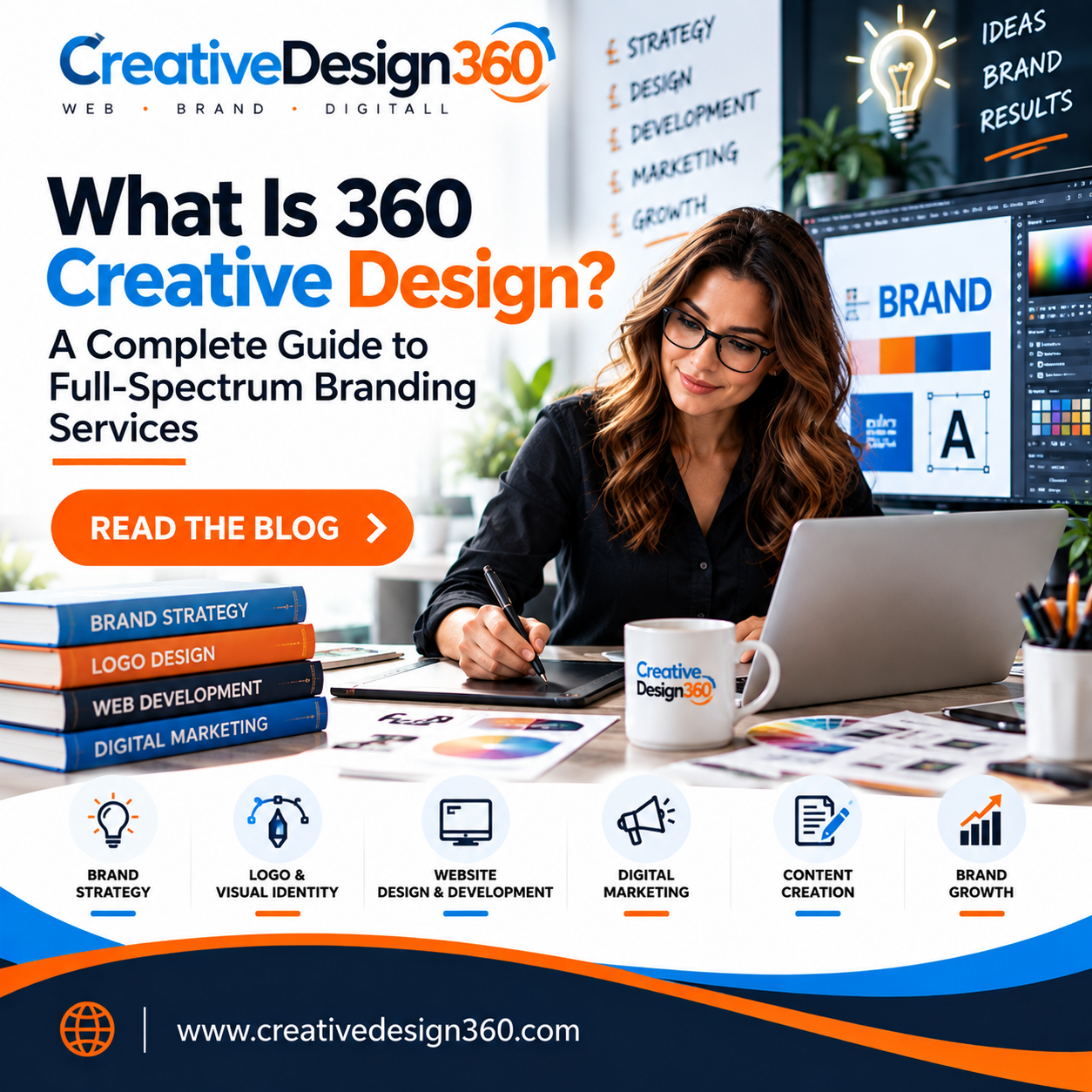
What Is 360 Creative Design? A Complete Guide to Full-Spectrum Branding Services
A company can have a beautiful logo and still have a poorly designed brand.
The problem usually appears later: the website feels like it belongs to someone else, social graphics use different colors, sales presentations follow another visual style, and printed materials seem to have been created by a completely separate team. Nothing looks terrible on its own. Together, though, the brand feels strangely disconnected.
That is the problem 360 creative design is intended to solve.
Instead of treating a logo, website, packaging, social media graphics and advertising as separate design assignments, a full-spectrum approach considers them parts of the same visual system. The objective is not simply to produce more design work. It is to make every customer touchpoint feel like it came from the same company.
What Creative Design Is Really Supposed to Accomplish?
At its simplest, creative design is the strategic use of visual elements typography, color, imagery, layout, illustration, motion and composition to communicate an idea or identity.
The word creative can make the discipline sound purely artistic. It isn’t.
Good design has a job to do.
A logo needs to be recognizable. A website needs to make information easy to find. Packaging needs to attract attention while explaining the product. A social post has perhaps two seconds to make someone stop scrolling. A presentation needs to make complicated information easier to understand.
That means effective creative design services sit somewhere between art and problem-solving.
The aesthetics matter. So does what happens after someone sees them.
What Does “360” Mean in Creative Design?
“360” describes a complete view rather than a single service.
A conventional design engagement might involve creating a logo and handing over the files. A 360 approach asks a larger question: where will this brand appear, and what does it need to look like in each environment?
That can include brand identity, print materials, digital advertising, social content, packaging, website interfaces, motion graphics and emerging digital formats.
Think of a theater production. The audience sees the actors, but the experience depends on lighting, set design, sound, costumes and countless details that work together without calling attention to themselves.
Brand design works much the same way.
The customer should experience the consistency, not have to think about it.
Which Services Belong In a 360 Creative Design System?
There is no universal list because different businesses have different needs. Still, most full-spectrum programs revolve around several core disciplines.
| Service | What it can include | What it contributes |
| Brand Identity Design | Logo, colors, typography, guidelines and visual direction | Creates recognition and a consistent identity |
| 360 Graphic Design | Social graphics, brochures, advertisements, flyers and marketing collateral | Keeps communications visually connected |
| Website Design | UX/UI, page layouts, responsive design and landing pages | Turns brand identity into a digital experience |
| 360 Website Design | Design, development coordination, responsive structure and conversion-focused pages | Creates a cohesive online presence |
| Digital & NFT Design | Digital artwork, collectibles and specialized Web3 assets | Extends the brand into emerging formats |
| AV & Motion Design | Animated logos, presentations, video graphics and visual effects | Gives the brand movement and presence on screen |
The value is not in checking every box.
A business that has no reason to create NFT assets does not need them simply because a studio offers NFT design services. The same principle applies to motion graphics, packaging or large-scale print.
Good creative direction starts with the communication problem, then selects the appropriate tools.
Why Does Brand Consistency Matter So Much?
Imagine walking into a hotel where the exterior sign uses one logo, the reception desk uses another, the room-service menu has different colors, and the website looks as though it belongs to an unrelated property.
Nothing necessarily looks awful.
The experience still feels unreliable.
Brands operate through the accumulation of these small impressions. A consistent visual identity makes it easier for customers to recognize the business and understand that different communications belong to the same organization.
This is one reason a capable creative design team thinks beyond individual files. It establishes rules that can survive across different formats, people and campaigns.
That might mean defining how photography should look, which typefaces can be used, how much space should surround the logo, which colors belong to which situations and how visual hierarchy should work.
Those details can sound mundane.
They are often where consistency is won.
Does a Business Really Need a 360 Design Studio?
Not every company does.
A small business needing a single event flyer probably does not need a full creative department. Hiring a specialist for a narrowly defined project can be perfectly sensible.
The calculation changes when the number of touchpoints starts multiplying.
A growing company may need a website redesign, social templates, sales presentations, paid advertising graphics, packaging, email designs and updated brand guidelines within the same year. Managing all of those through unrelated vendors creates another job: keeping the vendors aligned.
That is where a 360 design studio can become useful.
One team can maintain the underlying visual logic while adapting it to different formats.
The benefit is less about convenience than continuity.
How is 360 Branding Different from Simply Having a Logo?
A logo identifies a business.
360 branding gives the business a broader visual and verbal framework.
It can determine how the company looks on a website, how an advertisement feels, how a presentation is structured and how a social campaign extends an existing identity rather than inventing a new one.
This distinction becomes especially useful during growth. A founder may personally approve every early design. At 20 employees, three marketing channels and several outside vendors, that approach becomes difficult to sustain.
Brand guidelines then become more than a document.
They become institutional memory.
What Should Businesses Look For In a Creative Design Agency?
A polished portfolio is useful, but it is only the first filter.
A stronger evaluation looks at how the agency thinks.
Can it explain why a particular visual direction was chosen? Can it show how one identity adapts across different formats? Does its work demonstrate consistency without becoming repetitive? Can the team explain the difference between a design that looks attractive and one that solves a communication problem?
Service breadth matters too.
A company considering web design 360, brand identity and ongoing marketing collateral may benefit from a partner capable of handling those pieces within one system. A business working in emerging digital spaces might also ask whether the agency has relevant experience with NFT design studio work or other specialized formats.
There is one practical test that often gets overlooked: ask to see the less glamorous work.
Brand guidelines. Presentation decks. Email templates. Internal documents.
Anyone can make a striking homepage mockup. The real test is whether the visual system remains coherent when it has to live in ordinary places.
Is a 360 Design Studio Better Than a Traditional Design Agency?
“Better” depends on the assignment.
A specialist agency can be extremely valuable when a company needs deep expertise in one discipline. A studio built around design 360, by contrast, is structured to connect multiple creative disciplines under one visual direction.
The difference can be thought of as a workshop versus an orchestra.
A specialist may be exceptional at one instrument. A multidisciplinary team has the advantage when several instruments need to sound like one composition.
For a rebrand, product launch or business expansion across multiple channels, that coordination can save substantial time. For a small one-off design task, it may be unnecessary.
The right model follows the complexity of the work.
Where Does 360 Website Design Fit into the Bigger Picture?
A website is often the place where a brand system is tested most severely.
Print allows a designer considerable control over the final output. Websites have to work across screen sizes, browsers, devices and user behaviors. They also need to communicate information, support navigation and often encourage a specific action.
That makes 360 website design more than making a website visually attractive.
The brand identity has to translate into interface design, content hierarchy, buttons, imagery, spacing, interaction patterns and responsive layouts. A strong web design 360 process considers the entire experience rather than treating individual pages as isolated compositions.
A beautiful website that users cannot navigate is still a poor design solution.
What About NFT and Other Emerging Digital Design?
The presence of NFT design services in a full-spectrum offering deserves some context.
NFTs were once presented as an inevitable next stage of digital branding. The market has since become considerably more selective, and businesses should not treat digital collectibles as an automatic requirement.
Still, the underlying design discipline has broader relevance.
Brands increasingly create digital assets for virtual environments, online communities, interactive campaigns, gaming ecosystems and other screen-based experiences. An NFT design studio may therefore bring skills in digital illustration, 3D artwork, animation and asset systems that extend beyond NFTs themselves.
The technology may change.
The design problem remains familiar: how should an identity behave in a new environment?
What Is the Future of Full-Spectrum Creative Design?
The most interesting change may not be another design format at all.
It is the growing relationship between technology and creative production.
AI-assisted tools can accelerate repetitive tasks, generate exploratory concepts and help teams produce variations at a scale that would previously have taken considerably longer. That does not eliminate the need for designers. It shifts more attention toward direction, judgment, editing and brand strategy.
There is a useful historical parallel here. Photography did not eliminate painting; it changed what painting needed to do. Desktop publishing did not eliminate graphic designers; it changed how production worked.
The same pattern may emerge with AI.
The tools get faster. Judgment becomes more valuable.
Meanwhile, omnichannel communication continues to make consistency harder. A single campaign may need website graphics, social assets, mobile layouts, video, presentation slides, advertising variations and physical materials. A fragmented production process can struggle to keep those pieces aligned.
This is where 360 creative solutions have their strongest practical argument: not that one company must produce everything, but that someone needs to understand how everything fits together.
What Does a 360 Creative Approach Look Like?
It starts with a brand idea and builds a visual system around it.
The logo is one expression of that system. The website is another. Packaging, advertising, presentations, social media, motion and digital assets become further expressions not unrelated creative projects.
That is the real meaning of creative 360.
It is less about doing 360 different things and more about seeing the entire brand from 360 degrees.
For businesses operating across multiple channels, that perspective can make creative work more coherent, easier to manage and considerably more recognizable. And when the visual system is built properly, the individual pieces stop competing for attention.
They start working together.A company can have a beautiful logo and still have a poorly designed brand.
The problem usually appears later: the website feels like it belongs to someone else, social graphics use different colors, sales presentations follow another visual style, and printed materials seem to have been created by a completely separate team. Nothing looks terrible on its own. Together, though, the brand feels strangely disconnected.
That is the problem 360 creative design is intended to solve.
Instead of treating a logo, website, packaging, social media graphics and advertising as separate design assignments, a full-spectrum approach considers them parts of the same visual system. The objective is not simply to produce more design work. It is to make every customer touchpoint feel like it came from the same company.
What Creative Design Is Really Supposed to Accomplish?
At its simplest, creative design is the strategic use of visual elements typography, color, imagery, layout, illustration, motion and composition to communicate an idea or identity.
The word creative can make the discipline sound purely artistic. It isn’t.
Good design has a job to do.
A logo needs to be recognizable. A website needs to make information easy to find. Packaging needs to attract attention while explaining the product. A social post has perhaps two seconds to make someone stop scrolling. A presentation needs to make complicated information easier to understand.
That means effective creative design services sit somewhere between art and problem-solving.
The aesthetics matter. So does what happens after someone sees them.
What Does “360” Mean in Creative Design?
“360” describes a complete view rather than a single service.
A conventional design engagement might involve creating a logo and handing over the files. A 360 approach asks a larger question: where will this brand appear, and what does it need to look like in each environment?
That can include brand identity, print materials, digital advertising, social content, packaging, website interfaces, motion graphics and emerging digital formats.
Think of a theater production. The audience sees the actors, but the experience depends on lighting, set design, sound, costumes and countless details that work together without calling attention to themselves.
Brand design works much the same way.
The customer should experience the consistency, not have to think about it.
Which Services Belong In a 360 Creative Design System?
There is no universal list because different businesses have different needs. Still, most full-spectrum programs revolve around several core disciplines.
Service What it can include What it contributes
Brand Identity Design Logo, colors, typography, guidelines and visual direction Creates recognition and a consistent identity
360 Graphic Design Social graphics, brochures, advertisements, flyers and marketing collateral Keeps communications visually connected
Website Design UX/UI, page layouts, responsive design and landing pages Turns brand identity into a digital experience
360 Website Design Design, development coordination, responsive structure and conversion-focused pages Creates a cohesive online presence
Digital & NFT Design Digital artwork, collectibles and specialized Web3 assets Extends the brand into emerging formats
AV & Motion Design Animated logos, presentations, video graphics and visual effects Gives the brand movement and presence on screen
The value is not in checking every box.
A business that has no reason to create NFT assets does not need them simply because a studio offers NFT design services. The same principle applies to motion graphics, packaging or large-scale print.
Good creative direction starts with the communication problem, then selects the appropriate tools.
Why Does Brand Consistency Matter So Much?
Imagine walking into a hotel where the exterior sign uses one logo, the reception desk uses another, the room-service menu has different colors, and the website looks as though it belongs to an unrelated property.
Nothing necessarily looks awful.
The experience still feels unreliable.
Brands operate through the accumulation of these small impressions. A consistent visual identity makes it easier for customers to recognize the business and understand that different communications belong to the same organization.
This is one reason a capable creative design team thinks beyond individual files. It establishes rules that can survive across different formats, people and campaigns.
That might mean defining how photography should look, which typefaces can be used, how much space should surround the logo, which colors belong to which situations and how visual hierarchy should work.
Those details can sound mundane.
They are often where consistency is won.
Does a Business Really Need a 360 Design Studio?
Not every company does.
A small business needing a single event flyer probably does not need a full creative department. Hiring a specialist for a narrowly defined project can be perfectly sensible.
The calculation changes when the number of touchpoints starts multiplying.
A growing company may need a website redesign, social templates, sales presentations, paid advertising graphics, packaging, email designs and updated brand guidelines within the same year. Managing all of those through unrelated vendors creates another job: keeping the vendors aligned.
That is where a 360 design studio can become useful.
One team can maintain the underlying visual logic while adapting it to different formats.
The benefit is less about convenience than continuity.
How is 360 Branding Different from Simply Having a Logo?
A logo identifies a business.
360 branding gives the business a broader visual and verbal framework.
It can determine how the company looks on a website, how an advertisement feels, how a presentation is structured and how a social campaign extends an existing identity rather than inventing a new one.
This distinction becomes especially useful during growth. A founder may personally approve every early design. At 20 employees, three marketing channels and several outside vendors, that approach becomes difficult to sustain.
Brand guidelines then become more than a document.
They become institutional memory.
What Should Businesses Look For In a Creative Design Agency?
A polished portfolio is useful, but it is only the first filter.
A stronger evaluation looks at how the agency thinks.
Can it explain why a particular visual direction was chosen? Can it show how one identity adapts across different formats? Does its work demonstrate consistency without becoming repetitive? Can the team explain the difference between a design that looks attractive and one that solves a communication problem?
Service breadth matters too.
A company considering web design 360, brand identity and ongoing marketing collateral may benefit from a partner capable of handling those pieces within one system. A business working in emerging digital spaces might also ask whether the agency has relevant experience with NFT design studio work or other specialized formats.
There is one practical test that often gets overlooked: ask to see the less glamorous work.
Brand guidelines. Presentation decks. Email templates. Internal documents.
Anyone can make a striking homepage mockup. The real test is whether the visual system remains coherent when it has to live in ordinary places.
Is a 360 Design Studio Better Than a Traditional Design Agency?
“Better” depends on the assignment.
A specialist agency can be extremely valuable when a company needs deep expertise in one discipline. A studio built around design 360, by contrast, is structured to connect multiple creative disciplines under one visual direction.
The difference can be thought of as a workshop versus an orchestra.
A specialist may be exceptional at one instrument. A multidisciplinary team has the advantage when several instruments need to sound like one composition.
For a rebrand, product launch or business expansion across multiple channels, that coordination can save substantial time. For a small one-off design task, it may be unnecessary.
The right model follows the complexity of the work.
Where Does 360 Website Design Fit into the Bigger Picture?
A website is often the place where a brand system is tested most severely.
Print allows a designer considerable control over the final output. Websites have to work across screen sizes, browsers, devices and user behaviors. They also need to communicate information, support navigation and often encourage a specific action.
That makes 360 website design more than making a website visually attractive.
The brand identity has to translate into interface design, content hierarchy, buttons, imagery, spacing, interaction patterns and responsive layouts. A strong web design 360 process considers the entire experience rather than treating individual pages as isolated compositions.
A beautiful website that users cannot navigate is still a poor design solution.
What About NFT and Other Emerging Digital Design?
The presence of NFT design services in a full-spectrum offering deserves some context.
NFTs were once presented as an inevitable next stage of digital branding. The market has since become considerably more selective, and businesses should not treat digital collectibles as an automatic requirement.
Still, the underlying design discipline has broader relevance.
Brands increasingly create digital assets for virtual environments, online communities, interactive campaigns, gaming ecosystems and other screen-based experiences. An NFT design studio may therefore bring skills in digital illustration, 3D artwork, animation and asset systems that extend beyond NFTs themselves.
The technology may change.
The design problem remains familiar: how should an identity behave in a new environment?
What Is the Future of Full-Spectrum Creative Design?
The most interesting change may not be another design format at all.
It is the growing relationship between technology and creative production.
AI-assisted tools can accelerate repetitive tasks, generate exploratory concepts and help teams produce variations at a scale that would previously have taken considerably longer. That does not eliminate the need for designers. It shifts more attention toward direction, judgment, editing and brand strategy.
There is a useful historical parallel here. Photography did not eliminate painting; it changed what painting needed to do. Desktop publishing did not eliminate graphic designers; it changed how production worked.
The same pattern may emerge with AI.
The tools get faster. Judgment becomes more valuable.
Meanwhile, omnichannel communication continues to make consistency harder. A single campaign may need website graphics, social assets, mobile layouts, video, presentation slides, advertising variations and physical materials. A fragmented production process can struggle to keep those pieces aligned.
This is where 360 creative solutions have their strongest practical argument: not that one company must produce everything, but that someone needs to understand how everything fits together.
What Does a 360 Creative Approach Look Like?
It starts with a brand idea and builds a visual system around it.
The logo is one expression of that system. The website is another. Packaging, advertising, presentations, social media, motion and digital assets become further expressions not unrelated creative projects.
That is the real meaning of creative 360.
It is less about doing 360 different things and more about seeing the entire brand from 360 degrees.
For businesses operating across multiple channels, that perspective can make creative work more coherent, easier to manage and considerably more recognizable. And when the visual system is built properly, the individual pieces stop competing for attention.
They start working together.