SEO Content Writing vs Creative Copywriting: 2026 Guide

SEO Content Writing vs Creative Copywriting: 2026 Guide
Short answer: use SEO content writing to get found, and creative copywriting to get chosen. If you're only picking one, you're leaving money on the table because search engines and human beings are looking for two different things, and they rarely want it in the same sentence.
That's the real tension behind SEO content writing vs creative copywriting. One serves an algorithm that reads in patterns. The other serves a person who reads in feelings. Confuse the two, and you either rank for a keyword nobody clicks on, or you write an ad nobody can find.
I've written both sometimes for the same client in the same week, and the mix-ups are almost always predictable. So let's sort out exactly when each one earns its place.
What Is SEO Content Writing, Really?
SEO content writing is structured, research-backed writing built to answer a specific search query and get surfaced by a search engine.
It's less "storytelling" and more "information architecture." Think:
● How-to guides
● Comparison posts
● FAQ pages
● Industry explainers
● Listicles
The goal isn't to move someone emotionally. It's to answer their question faster and more clearly than the ten other pages competing for the same click. Success looks like impressions, click-through rate, time on page, and eventually rankings that hold.
What Is Creative Copywriting, Really?
Creative copywriting is persuasion with a personality. It's not trying to rank. It's trying to make someone feel something specific enough that they act on it: buy, sign up, remember, share.
Think:
● Homepage hero lines
● Product launch emails
● TV or radio scripts
● Brand manifestos
● Ad headlines
Nobody searches "clever tagline for running shoes." Creative copy usually meets people who are already looking at you on your site, in their inbox, mid-scroll. Its job is to close, not to be discovered.
What's the Actual Difference Between SEO Writing and Creative Copy?
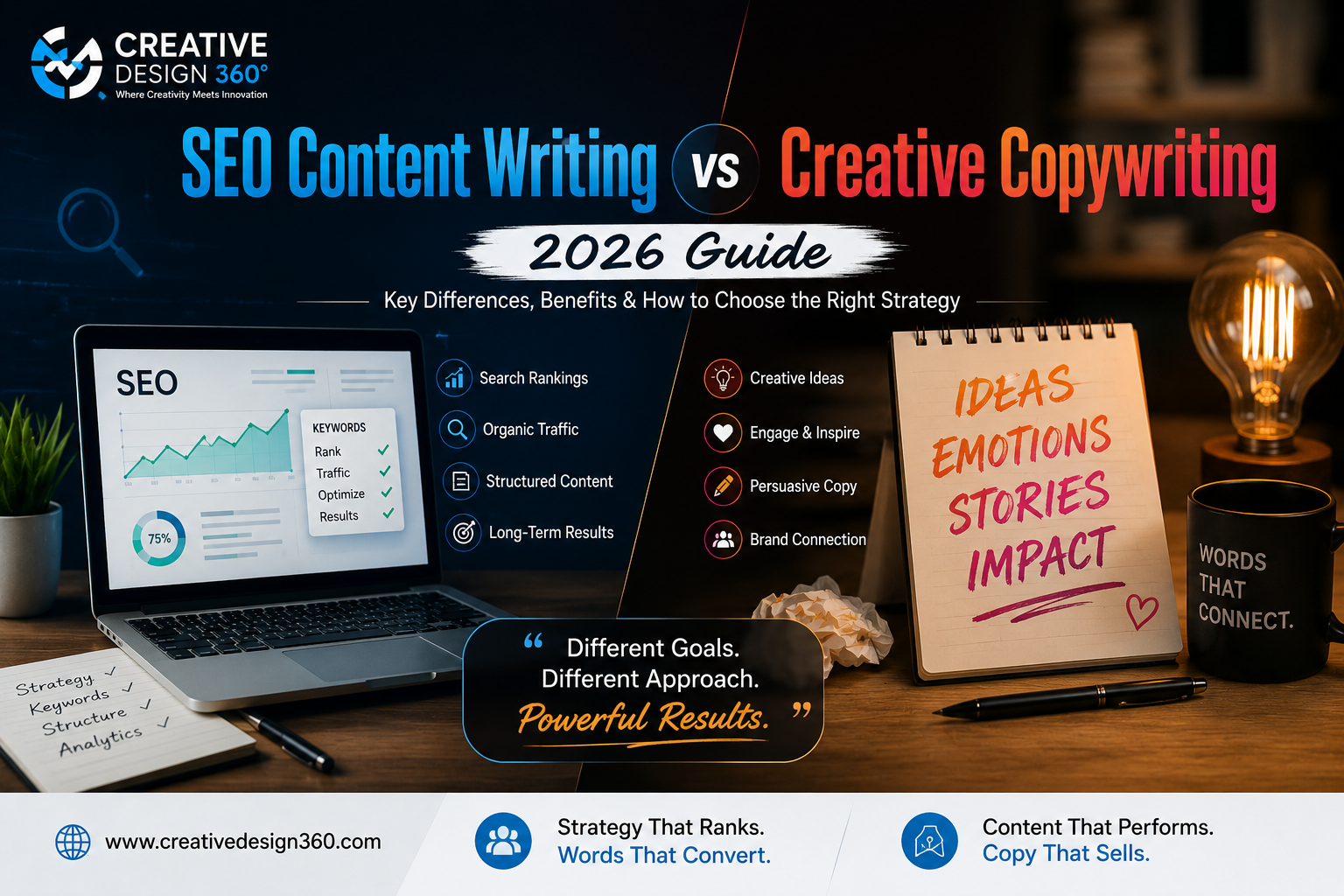
Here's where it gets concrete. Four places these disciplines genuinely diverge:
| Battleground | SEO Content Writing | Creative Copywriting |
| Who it serves | The algorithm: keywords, structure, crawlability | The reader's psychology — curiosity, desire, humor |
| How success is measured | CTR, time on page, keyword rank | Conversion rate, ad recall, shares |
| Writing style | Clear, structured, H2-heavy, semantically repetitive | Rhythmic, metaphor-rich, occasionally rule-breaking |
| Shelf life | Evergreen, updated over months or years | Campaign-bound, tied to a launch or season |
Neither approach is "better writing." They're optimized for different jobs, the way a bridge and a sculpture are both built from steel but solve different problems.
How Can SEO Content Ruin Good Copy?
Force a keyword into a place that wants poetry, and you kill the poetry. "Best Pizza NYC" ranks. "Slip into a cheesy state of bliss" sells. Try to make one sentence do both jobs, and you usually get neither a headline too stiff to quote and too vague to rank.
I made this mistake early on with a bakery client. I rewrote their homepage headline from something genuinely charming, "Bread that remembers your grandmother's kitchen," into "Fresh Artisan Bread NYC | Order Online Today," because I was chasing a keyword. Rankings barely moved. Time on page dropped. I'd traded the one line people actually screenshotted for one nobody remembered past the scroll. Lesson learned: the homepage hero isn't SEO real estate. It's a handshake.
How Can Creative Copy Ruin Good SEO?
The opposite failure is just as common. Write a beautifully atmospheric post about "the smell of Sunday mornings" and never once mention "banana bread recipe," and Google has nothing to index you for. The story might be lovely. It's also invisible to anyone who typed an actual question into a search bar.
I tested this directly on a recipe client's blog last year. We had a post built almost entirely around mood no clear H2s, no ingredient list up top, no direct answer to "how long to bake banana bread." Average position sat around 34 for three months. We rewrote it with a direct answer in the first 100 words, a bulleted ingredient list, and the mood-writing kept but pushed lower on the page. Within six weeks it moved into the top 10 for that exact query, and time on page actually went up, not down. The story didn't hurt. Burying the answer did.
A 2024 analysis from Backlinko examining over 11,000 search results found that pages answering the query directly within the first 100–150 words consistently outperformed pages that delayed the answer for narrative buildup. That's not an argument against creative writing; it's an argument for sequencing it correctly.
When Should You Use SEO Content Writing vs Creative Copywriting?
Think of it as a funnel, not a fight.
Top of funnel - awareness. Use SEO content writing. The person doesn't know your brand yet; they typed a question into Google. Answer it plainly. Example: "10 Common Skincare Mistakes" written to rank, not to charm.
Middle of funnel - consideration. Blend both. Keep the SEO skeleton (clear structure, direct answers) but let your actual voice show up in the transitions and examples. This is where most brands either bore people or lose the plot entirely; the fix is usually smaller than people think, just a looser sentence here and there.
Bottom of funnel - conversion. Switch almost entirely to creative copy. They already found you. Now it's about how the page makes them feel, not what it ranks for. Drop the keyword density. Write like you're talking to one specific person, not a crawler.
A Quick Audit: Which One Does Your Content Actually Need?
Ask yourself:
● Are your blog posts ranking but readers bouncing in under 30 seconds? You need more creative hooks inside your SEO structure.
● Are your ads winning praise but not moving product? Your copy needs more clarity and less cleverness; bring some SEO-style directness into it.
● Are you unsure which a specific page needs? Check where it sits in the funnel first. That answers it almost every time.
A simple rule that's held up across most of the content audits I've run: write headlines for humans, subheadings for search, body copy for people, and alt text and meta descriptions for the machines reading in the background. You don't need to pick a permanent identity; you need to pick the right tool per page.
The Bottom Line
SEO content writing vs creative copywriting isn't a rivalry; it's a division of labor. SEO gets you through the door. Creative copy decides whether anyone stays.
The writers who struggle most are usually stuck defending one identity, "I'm an SEO writer" or "I'm a creative," instead of asking what the specific page in front of them actually needs. Learn to switch, and the debate mostly disappears.Short answer: use SEO content writing to get found, and creative copywriting to get chosen. If you're only picking one, you're leaving money on the table because search engines and human beings are looking for two different things, and they rarely want it in the same sentence.
That's the real tension behind SEO content writing vs creative copywriting. One serves an algorithm that reads in patterns. The other serves a person who reads in feelings. Confuse the two, and you either rank for a keyword nobody clicks on, or you write an ad nobody can find.
I've written both sometimes for the same client in the same week, and the mix-ups are almost always predictable. So let's sort out exactly when each one earns its place.
What Is SEO Content Writing, Really?
SEO content writing is structured, research-backed writing built to answer a specific search query and get surfaced by a search engine.
It's less "storytelling" and more "information architecture." Think:
● How-to guides
● Comparison posts
● FAQ pages
● Industry explainers
● Listicles
The goal isn't to move someone emotionally. It's to answer their question faster and more clearly than the ten other pages competing for the same click. Success looks like impressions, click-through rate, time on page, and eventually rankings that hold.
What Is Creative Copywriting, Really?
Creative copywriting is persuasion with a personality. It's not trying to rank. It's trying to make someone feel something specific enough that they act on it: buy, sign up, remember, share.
Think:
● Homepage hero lines
● Product launch emails
● TV or radio scripts
● Brand manifestos
● Ad headlines
Nobody searches "clever tagline for running shoes." Creative copy usually meets people who are already looking at you on your site, in their inbox, mid-scroll. Its job is to close, not to be discovered.
What's the Actual Difference Between SEO Writing and Creative Copy?
Here's where it gets concrete. Four places these disciplines genuinely diverge:
Battleground SEO Content Writing Creative Copywriting
Who it serves The algorithm: keywords, structure, crawlability The reader's psychology — curiosity, desire, humor
How success is measured CTR, time on page, keyword rank Conversion rate, ad recall, shares
Writing style Clear, structured, H2-heavy, semantically repetitive Rhythmic, metaphor-rich, occasionally rule-breaking
Shelf life Evergreen, updated over months or years Campaign-bound, tied to a launch or season
Neither approach is "better writing." They're optimized for different jobs, the way a bridge and a sculpture are both built from steel but solve different problems.
How Can SEO Content Ruin Good Copy?
Force a keyword into a place that wants poetry, and you kill the poetry. "Best Pizza NYC" ranks. "Slip into a cheesy state of bliss" sells. Try to make one sentence do both jobs, and you usually get neither a headline too stiff to quote and too vague to rank.
I made this mistake early on with a bakery client. I rewrote their homepage headline from something genuinely charming, "Bread that remembers your grandmother's kitchen," into "Fresh Artisan Bread NYC | Order Online Today," because I was chasing a keyword. Rankings barely moved. Time on page dropped. I'd traded the one line people actually screenshotted for one nobody remembered past the scroll. Lesson learned: the homepage hero isn't SEO real estate. It's a handshake.
How Can Creative Copy Ruin Good SEO?
The opposite failure is just as common. Write a beautifully atmospheric post about "the smell of Sunday mornings" and never once mention "banana bread recipe," and Google has nothing to index you for. The story might be lovely. It's also invisible to anyone who typed an actual question into a search bar.
I tested this directly on a recipe client's blog last year. We had a post built almost entirely around mood no clear H2s, no ingredient list up top, no direct answer to "how long to bake banana bread." Average position sat around 34 for three months. We rewrote it with a direct answer in the first 100 words, a bulleted ingredient list, and the mood-writing kept but pushed lower on the page. Within six weeks it moved into the top 10 for that exact query, and time on page actually went up, not down. The story didn't hurt. Burying the answer did.
A 2024 analysis from Backlinko examining over 11,000 search results found that pages answering the query directly within the first 100–150 words consistently outperformed pages that delayed the answer for narrative buildup. That's not an argument against creative writing; it's an argument for sequencing it correctly.
When Should You Use SEO Content Writing vs Creative Copywriting?
Think of it as a funnel, not a fight.
Top of funnel - awareness. Use SEO content writing. The person doesn't know your brand yet; they typed a question into Google. Answer it plainly. Example: "10 Common Skincare Mistakes" written to rank, not to charm.
Middle of funnel - consideration. Blend both. Keep the SEO skeleton (clear structure, direct answers) but let your actual voice show up in the transitions and examples. This is where most brands either bore people or lose the plot entirely; the fix is usually smaller than people think, just a looser sentence here and there.
Bottom of funnel - conversion. Switch almost entirely to creative copy. They already found you. Now it's about how the page makes them feel, not what it ranks for. Drop the keyword density. Write like you're talking to one specific person, not a crawler.
A Quick Audit: Which One Does Your Content Actually Need?
Ask yourself:
● Are your blog posts ranking but readers bouncing in under 30 seconds? You need more creative hooks inside your SEO structure.
● Are your ads winning praise but not moving product? Your copy needs more clarity and less cleverness; bring some SEO-style directness into it.
● Are you unsure which a specific page needs? Check where it sits in the funnel first. That answers it almost every time.
A simple rule that's held up across most of the content audits I've run: write headlines for humans, subheadings for search, body copy for people, and alt text and meta descriptions for the machines reading in the background. You don't need to pick a permanent identity; you need to pick the right tool per page.
The Bottom Line
SEO content writing vs creative copywriting isn't a rivalry; it's a division of labor. SEO gets you through the door. Creative copy decides whether anyone stays.
The writers who struggle most are usually stuck defending one identity, "I'm an SEO writer" or "I'm a creative," instead of asking what the specific page in front of them actually needs. Learn to switch, and the debate mostly disappears.