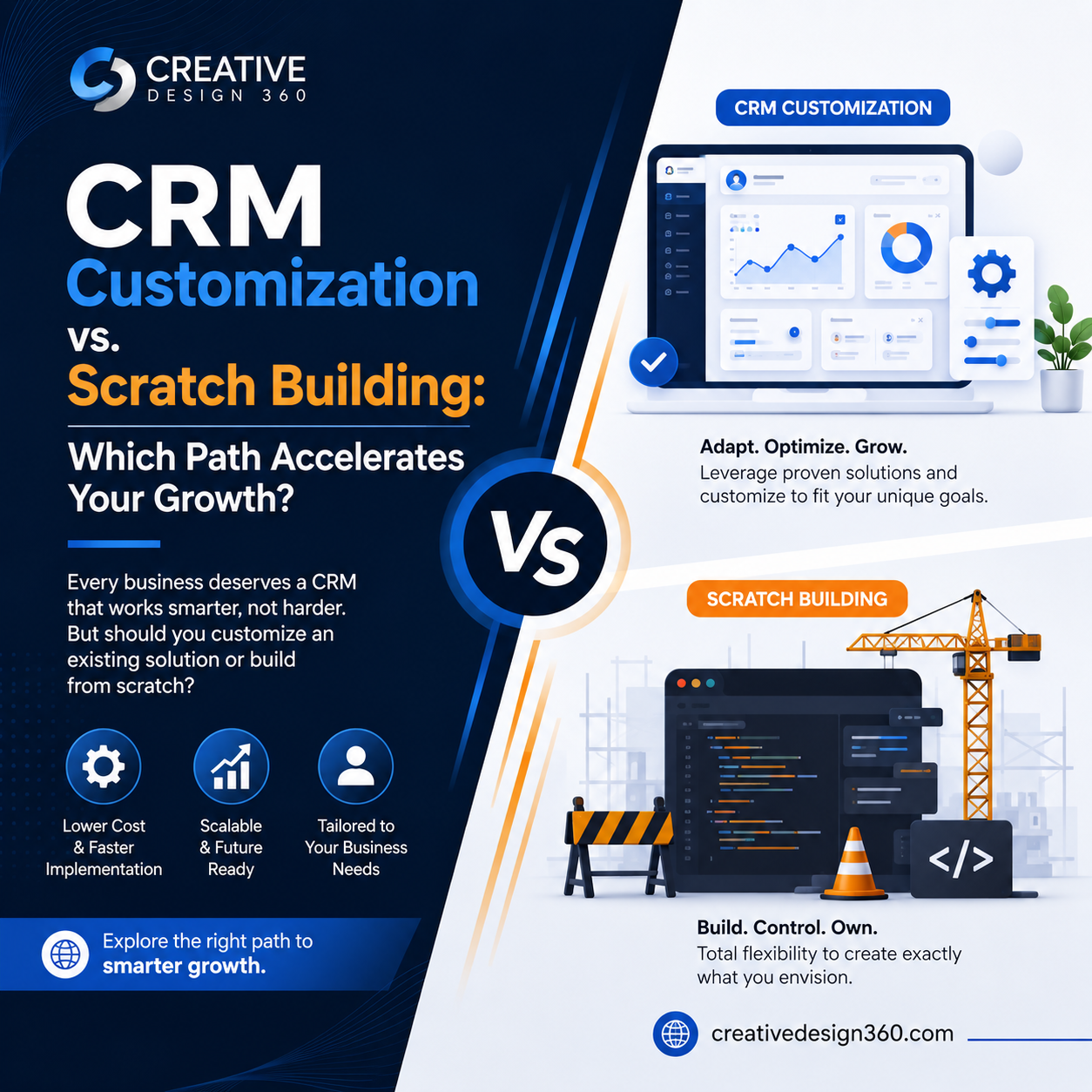
CRM Customization vs. Scratch Building: Which Path Accelerates Your Growth?

CRM Customization vs. Scratch Building: Which Path Accelerates Your Growth?
Choosing a good customer relationship management strategy can drive your company to success. Customer data powers sales pipelines, marketing automation, and revenue forecasting. When existing platforms outgrow initial setups, business leaders face choices. Should you customize established platforms or build proprietary software tools? In other words, the decision is about CRM integration vs building a CRM from scratch.
Both strategies offer clear growth paths, but timelines differ greatly. Selecting the wrong option drains engineering hours and stalls momentum. Comparing both methods across essential factors clarifies your best path.
Understanding the Strategic Software Options
Defining both strategies helps evaluate speed, budget, and system complexity.
Path A: Comprehensive CRM Customization
Platform customization adapts established software to your specific business processes. This process goes far beyond adding fields or basic templates. Deep customization connects internal systems through robust application programming interfaces. Automated workflows mirror complex sales cycles and custom data fields. Tailored user dashboards provide clear reporting for every department head. Low-code tools and app marketplaces extend baseline platform capabilities.
Enterprise organizations frequently leverage existing platforms to save valuable time. They configure user permission levels to maintain strict internal governance. They map customer touchpoints across email, phone, and website channels. Custom layouts present critical information directly to active sales reps. Third-party extensions add missing functionality without extra custom coding.
Path B: Proprietary Scratch Building
Building custom software creates proprietary database systems from the start. Internal developers design, test, launch, and maintain every single component. Your engineering team constructs user permissions, security protocols, and features. This approach requires continuous internal attention and long-term maintenance.
Building software internally gives your team total ownership of code. You control data storage locations to meet custom compliance requirements. No monthly user fees limit how many employees access data. However, building requires dedicated developers who manage servers and updates. Your engineering team must handle bugs and security patches continuously.
Evaluating Essential Business Growth Vectors
1. Speed to Value and Time to Market
Growth relies on fast execution across every customer-facing department. Quick tracking of prospective leads speeds up overall revenue generation.
· Customizing an Existing Tool: Established platforms provide ready infrastructure out of the box. Contact management and email tracking work on day one smoothly. Customizing these systems to fit workflows takes only several weeks. Sales teams quickly log interactions, close deals, and generate insights.
· Building from Scratch: Developing software from zero demands a lengthy engineering schedule. Defining specifications and writing code takes six to twelve months. Teams rely on temporary tools during this extended build period. Operational friction grows while employees wait for full software deployment.
Speed to market dictates how fast your revenue team operates. Delayed software deployment creates bottlenecks that slow down lead conversion. Customizing existing platforms lets sales reps start prospecting almost immediately. In contrast, building software leaves teams waiting on developer progress. Months spent coding mean missed deals and lost market share.
2. Capital Allocation and Total Cost of Ownership
Evaluating costs requires analyzing long-term commitments over several years.
· Customizing an Existing Tool: Financial models rely on predictable subscription fees and initial setup. Software licensing costs grow predictably as your employee headcounts expand. Vendors handle platform upgrades, security patches, and regulatory compliance updates.
· Building from Scratch: Initial development costs represent a small portion of overall investment. Proprietary platforms require continuous funding for server hosting and security. Engineering hours spent maintaining internal tools divert focus from products.
Software licensing fees remain small when compared to developer salaries. Building custom applications consumes valuable engineering budget every single month. Engineers assigned to internal tools cannot build customer-facing features. This trade-off creates significant opportunity cost for modern tech startups. Customizing existing software keeps initial capital expenditures predictable and low.
3. Workflow Flexibility vs. Feature Overkill
Matching software capability to needs requires an objective internal review.
· Customizing an Existing Tool: Enterprise tools offer extensive flexibility through webhooks and custom objects. You can modify data structures to mirror most business operations. However, teams must operate within the platform's set architectural boundaries. If software platform rate caps exist, workflows must adapt accordingly.
· Building from Scratch: Proprietary applications grant complete control over every feature and layout. Developers sculpt interface buttons and database schema around your exact rules. You never pay for unneeded features or conform to constraints. Unique business models benefit greatly from completely custom data relationships.
Most companies use standard sales funnels to generate new revenue. Leads enter the funnel, receive outreach, and convert to customers. Standard commercial software supports these common workflows without custom code. Only truly unique business models require building completely custom software. Building custom features for standard sales processes wastes engineering talent.
4. Ecosystem Integrations and AI Capabilities
Modern sales teams rely heavily on connected software applications daily.
· Customizing an Existing Tool: Market leaders offer massive marketplaces for popular business software. Connecting third-party tools takes just a few administrative clicks. Leading software vendors invest heavily in native artificial intelligence features.
· Building from Scratch: Hand-coding every application connection requires constant technical team oversight. Third-party software updates break custom code without constant developer attention. Implementing generative artificial intelligence requires complex modeling and added engineering.
Third-party integrations allow your sales stack to communicate seamlessly. Commercial platforms connect directly with tools like Stripe and Slack. Custom builds force developers to write and maintain every connection. When an external application updates, custom code often breaks down. Maintaining dozens of custom integrations creates a constant technical debt burden.
Strategic Comparison Matrix
· Customized platforms deploy within weeks, whereas custom software takes months.
· Initial customization costs stay moderate, but custom builds require millions.
· SaaS subscriptions remain predictable, while custom builds demand technical maintenance.
· Customized software minimizes engineering burdens, but custom builds require developers.
· Ecosystem integrations connect easily, whereas custom builds require manual APIs.
· Commercial platforms scale instantly, but custom builds demand server management.
Choosing between these options requires analyzing your core strategic capabilities. Companies must decide where to allocate limited engineering team hours. Customization allows teams to scale operations without taking technical risks. Custom builds give total control, but increase ongoing operational expenses.
How to Make the Right Strategic Choice
Evaluate your company against these three simple criteria to decide:
1. Is managing customer data your main external commercial product? Software companies should focus developers on products, not internal tools.
2. How standard is your current end-to-end sales pipeline? Standard sales processes fit existing software platforms without major issues.
3. What is your engineering team's current available work capacity? Busy technical teams struggle to build and maintain internal tools.
If your core product generates revenue, keep developers focused there. Do not distract engineering teams with building complex internal applications. Leverage existing software platforms to handle your routine customer data. Save custom software builds for features that directly impact customers.
Frequently Asked Questions
1. What is the average timeline difference between these two strategies?
Customizing platforms takes four to twelve weeks for most organizations. Building custom software from scratch requires six to twelve months.
2. When does building a custom platform make total business sense?
Custom builds suit companies with unique security rules or data. Proprietary data structures that standard platforms cannot support justify builds.
3. Can modern low-code tools completely replace custom scratch building?
Low-code platforms allow fast development of custom internal software. However, these tools still demand ongoing maintenance and database management.
4. How do ongoing software maintenance costs compare over time?
SaaS subscriptions cover security, server hosting, and regular system updates. Custom builds shift hosting, security, and maintenance directly to you.
5. Can a company start with custom software and migrate later?
Many businesses start with custom platforms to validate early operations. Companies export structured platform data to custom databases when necessary.Choosing a good customer relationship management strategy can drive your company to success. Customer data powers sales pipelines, marketing automation, and revenue forecasting. When existing platforms outgrow initial setups, business leaders face choices. Should you customize established platforms or build proprietary software tools? In other words, the decision is about CRM integration vs building a CRM from scratch.
Both strategies offer clear growth paths, but timelines differ greatly. Selecting the wrong option drains engineering hours and stalls momentum. Comparing both methods across essential factors clarifies your best path.
Understanding the Strategic Software Options
Defining both strategies helps evaluate speed, budget, and system complexity.
Path A: Comprehensive CRM Customization
Platform customization adapts established software to your specific business processes. This process goes far beyond adding fields or basic templates. Deep customization connects internal systems through robust application programming interfaces. Automated workflows mirror complex sales cycles and custom data fields. Tailored user dashboards provide clear reporting for every department head. Low-code tools and app marketplaces extend baseline platform capabilities.
Enterprise organizations frequently leverage existing platforms to save valuable time. They configure user permission levels to maintain strict internal governance. They map customer touchpoints across email, phone, and website channels. Custom layouts present critical information directly to active sales reps. Third-party extensions add missing functionality without extra custom coding.
Path B: Proprietary Scratch Building
Building custom software creates proprietary database systems from the start. Internal developers design, test, launch, and maintain every single component. Your engineering team constructs user permissions, security protocols, and features. This approach requires continuous internal attention and long-term maintenance.
Building software internally gives your team total ownership of code. You control data storage locations to meet custom compliance requirements. No monthly user fees limit how many employees access data. However, building requires dedicated developers who manage servers and updates. Your engineering team must handle bugs and security patches continuously.
Evaluating Essential Business Growth Vectors
1. Speed to Value and Time to Market
Growth relies on fast execution across every customer-facing department. Quick tracking of prospective leads speeds up overall revenue generation.
• Customizing an Existing Tool: Established platforms provide ready infrastructure out of the box. Contact management and email tracking work on day one smoothly. Customizing these systems to fit workflows takes only several weeks. Sales teams quickly log interactions, close deals, and generate insights.
• Building from Scratch: Developing software from zero demands a lengthy engineering schedule. Defining specifications and writing code takes six to twelve months. Teams rely on temporary tools during this extended build period. Operational friction grows while employees wait for full software deployment.
Speed to market dictates how fast your revenue team operates. Delayed software deployment creates bottlenecks that slow down lead conversion. Customizing existing platforms lets sales reps start prospecting almost immediately. In contrast, building software leaves teams waiting on developer progress. Months spent coding mean missed deals and lost market share.
2. Capital Allocation and Total Cost of Ownership
Evaluating costs requires analyzing long-term commitments over several years.
• Customizing an Existing Tool: Financial models rely on predictable subscription fees and initial setup. Software licensing costs grow predictably as your employee headcounts expand. Vendors handle platform upgrades, security patches, and regulatory compliance updates.
• Building from Scratch: Initial development costs represent a small portion of overall investment. Proprietary platforms require continuous funding for server hosting and security. Engineering hours spent maintaining internal tools divert focus from products.
Software licensing fees remain small when compared to developer salaries. Building custom applications consumes valuable engineering budget every single month. Engineers assigned to internal tools cannot build customer-facing features. This trade-off creates significant opportunity cost for modern tech startups. Customizing existing software keeps initial capital expenditures predictable and low.
3. Workflow Flexibility vs. Feature Overkill
Matching software capability to needs requires an objective internal review.
• Customizing an Existing Tool: Enterprise tools offer extensive flexibility through webhooks and custom objects. You can modify data structures to mirror most business operations. However, teams must operate within the platform's set architectural boundaries. If software platform rate caps exist, workflows must adapt accordingly.
• Building from Scratch: Proprietary applications grant complete control over every feature and layout. Developers sculpt interface buttons and database schema around your exact rules. You never pay for unneeded features or conform to constraints. Unique business models benefit greatly from completely custom data relationships.
Most companies use standard sales funnels to generate new revenue. Leads enter the funnel, receive outreach, and convert to customers. Standard commercial software supports these common workflows without custom code. Only truly unique business models require building completely custom software. Building custom features for standard sales processes wastes engineering talent.
4. Ecosystem Integrations and AI Capabilities
Modern sales teams rely heavily on connected software applications daily.
• Customizing an Existing Tool: Market leaders offer massive marketplaces for popular business software. Connecting third-party tools takes just a few administrative clicks. Leading software vendors invest heavily in native artificial intelligence features.
• Building from Scratch: Hand-coding every application connection requires constant technical team oversight. Third-party software updates break custom code without constant developer attention. Implementing generative artificial intelligence requires complex modeling and added engineering.
Third-party integrations allow your sales stack to communicate seamlessly. Commercial platforms connect directly with tools like Stripe and Slack. Custom builds force developers to write and maintain every connection. When an external application updates, custom code often breaks down. Maintaining dozens of custom integrations creates a constant technical debt burden.
Strategic Comparison Matrix
• Customized platforms deploy within weeks, whereas custom software takes months.
• Initial customization costs stay moderate, but custom builds require millions.
• SaaS subscriptions remain predictable, while custom builds demand technical maintenance.
• Customized software minimizes engineering burdens, but custom builds require developers.
• Ecosystem integrations connect easily, whereas custom builds require manual APIs.
• Commercial platforms scale instantly, but custom builds demand server management.
Choosing between these options requires analyzing your core strategic capabilities. Companies must decide where to allocate limited engineering team hours. Customization allows teams to scale operations without taking technical risks. Custom builds give total control, but increase ongoing operational expenses.
How to Make the Right Strategic Choice
Evaluate your company against these three simple criteria to decide:
1. Is managing customer data your main external commercial product? Software companies should focus developers on products, not internal tools.
2. How standard is your current end-to-end sales pipeline? Standard sales processes fit existing software platforms without major issues.
3. What is your engineering team's current available work capacity? Busy technical teams struggle to build and maintain internal tools.
If your core product generates revenue, keep developers focused there. Do not distract engineering teams with building complex internal applications. Leverage existing software platforms to handle your routine customer data. Save custom software builds for features that directly impact customers.
Frequently Asked Questions
1. What is the average timeline difference between these two strategies?
Customizing platforms takes four to twelve weeks for most organizations. Building custom software from scratch requires six to twelve months.
2. When does building a custom platform make total business sense?
Custom builds suit companies with unique security rules or data. Proprietary data structures that standard platforms cannot support justify builds.
3. Can modern low-code tools completely replace custom scratch building?
Low-code platforms allow fast development of custom internal software. However, these tools still demand ongoing maintenance and database management.
4. How do ongoing software maintenance costs compare over time?
SaaS subscriptions cover security, server hosting, and regular system updates. Custom builds shift hosting, security, and maintenance directly to you.
5. Can a company start with custom software and migrate later?
Many businesses start with custom platforms to validate early operations. Companies export structured platform data to custom databases when necessary.